

Seasonal Wonders: Summer

It's a balmy wash of red campion elbow-high, while the ocean horizon to the east is a fixed line drawn firmly in the sand. There's here, where I stand at the eastern edge of my county, gannets wheeling above my head like passenger planes coming in to land, and then beyond that fixed line of the North Sea where the gannets will soon go and none of us can follow.
Seabirds have truly been the soundtrack to my summer. Soaking up every windswept moment along the coast, their harsh and keening cries a melody I encounter for all but a few months. An intimate window into a world not unlike our own. Life, death, survival. Beauty, too. A carrion crow flies off with a guillemot egg pierced in its hooked beak. They'll try again next year.
More than ever, I have connected deeply to this colony of seabirds, which come in all shapes and sizes. These summer months are my last living at home. I'm moving across the country, sitting on the cusp of change and creation. But the ecology of my life is reflected in a vast mirror held up next to these birds. I know that I'll return to the cliffs to watch the spectacle all over again. There's always next year.

Beaks clattering together, throaty, monsyllabic vocalisations. Outstretched, the sunlight dances along their vast wingspans whilst they lumber around on clumsy webbed feet. There are not many things more magnetic than the courtship of gannets (Bassus moranus).
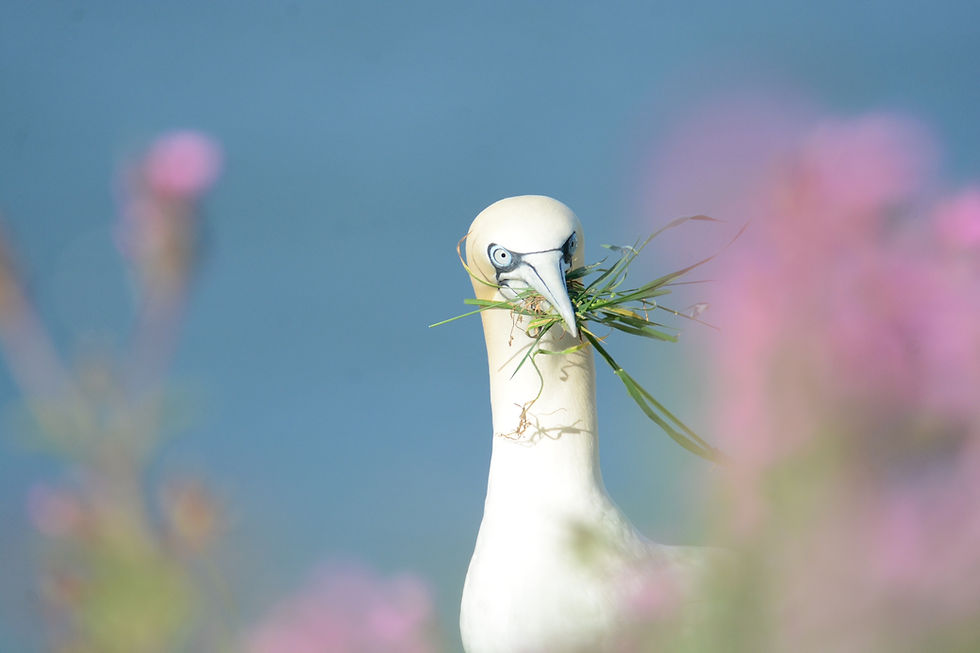
Through a haze of red campion, gannets pluck long stalks as nesting materials. Beak full of verdant green, piercing pools of ice they call eyes. The kohl-like ring around them stretches nearly to the tip of their pale beaks. Not to mention a wash of yellow, cloaking their head, against a snow-white plumage, wingtips dashed in black ink.
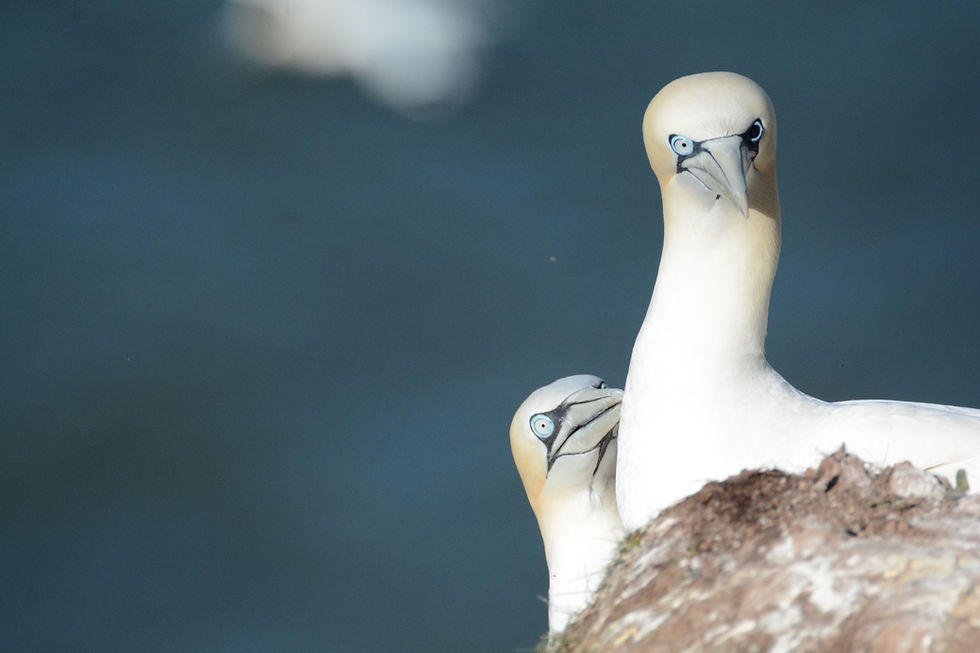
This gannet's eye colour has changed to black; the only sign of its survivor status. Avian influenza ripped through seabird colonies like this one in recent years, a destructive force of an epidemic that left death and decay in its wake. Colonies are recovering now, while gannets surviving the infection typically develop black irises.
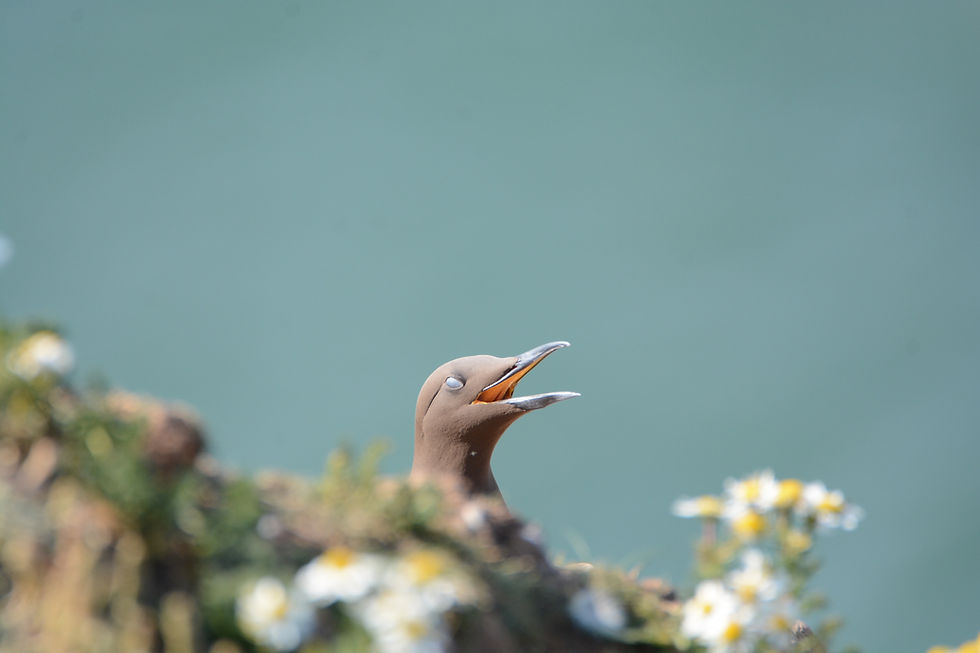
It's all about the eyes. A common guillemot (Uria aalge) peers over the headland, mid cry. A closer look reveals the nictitating membrane, a 'third-eyelid' possessed by almost all birds, acting as an in-built shield against high winds, sharp beaks and sand.
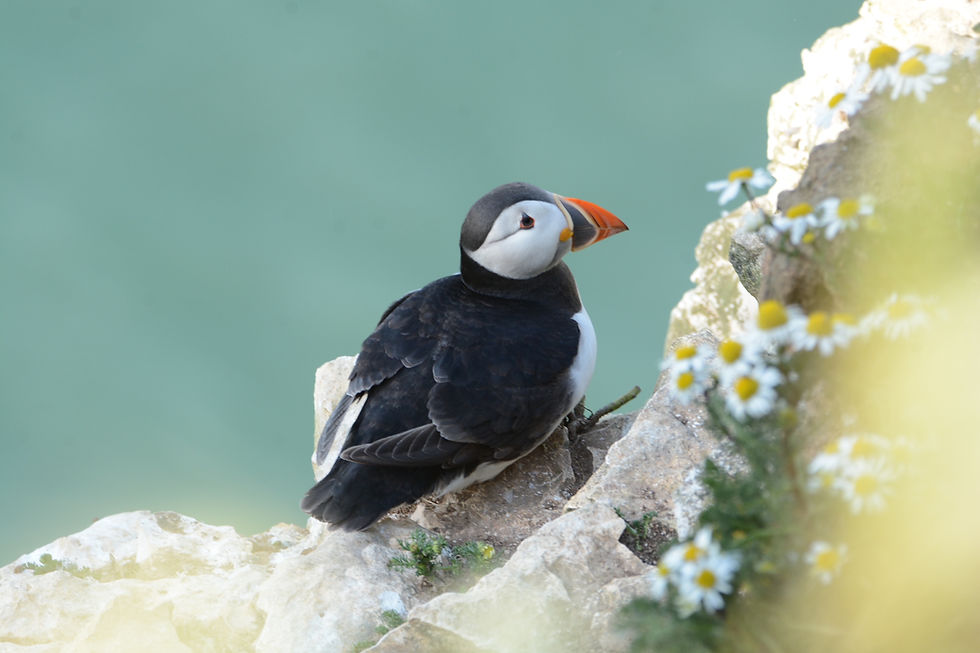
Sheltered against the rock face, an Atlantic puffin (Fratercula arctica) almost completely hidden from view. Through the daisies, the burnt orange beak is at odds with the striking black and white plumage. Its equally orange feet are tucked away. There's something incredibly endearing about puffins in a way I don't quite understand. But by the frenzy that builds among the birding community each spring, late in the season, I know they feel it too.
About the Author:
Madelaine is a Zoology and Science Communication graduate, now working as Engagement Officer for a natural history and heritage charity. Passionate about engagement with science and nature, and rediscovering a love of writing, she aims to document her experiences with the wild through blogs, wildlife photography, and tales of the natural world.

Comments